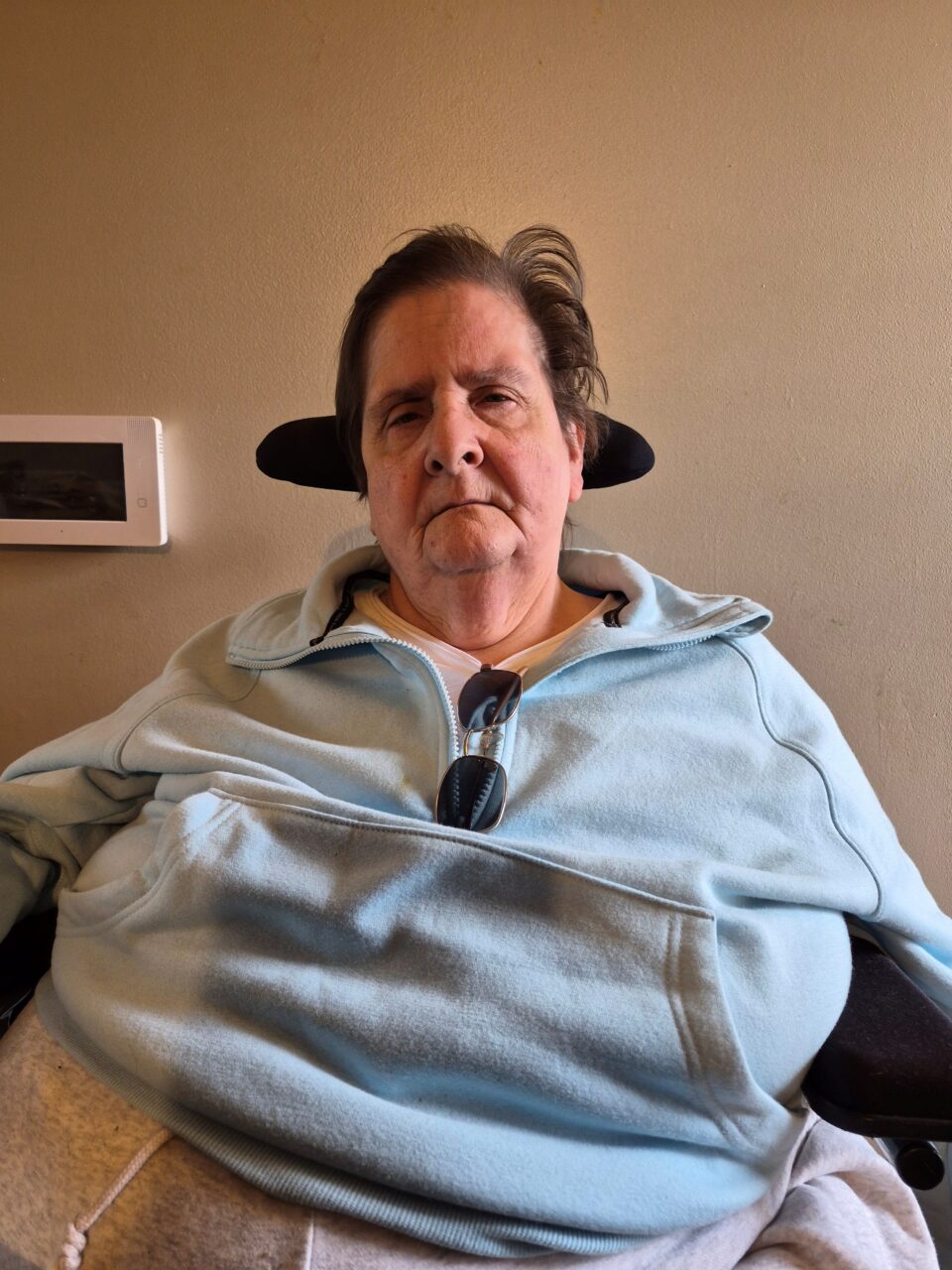
Cheryl Ebenal, who originates from Maidstone, Saskatchewan, learned early on that she would not let her disability dictate her life or what she chose to do with it. One of six children, Cheryl was born with spina bifida and was diagnosed with hydrocephalus in her twenties. She grew up on a farm in rural Saskatchewan and was expected to complete the same chores as her siblings, and she did. She fed the animals, milked the cows and did whatever else needed to be done.
Now 63, Cheryl lives in Saskatoon with her husband Russ.
Cheryl completed her education in Saskatoon and boarded with another family until she was in grade 10.
When she was 18, she moved to a semi-independent living facility, when her healthcare needs became more complex and she began to use a wheelchair.
Cheryl worked as an educational assistant for children who had learning disabilities. She later worked in a private childcare home, then as a telephone surveyor before returning to the education system supervising children in the lunchroom and school yard. She also volunteered on her local school board and parents’ association.
Coming from a big family and enjoying being around children, Cheryl wanted to be a mother, but her doctors told her and her parents that a pregnancy was very unlikely, and no one thought any more about it.
However, when she turned 20, she had her first child with her partner. When that relationship ended, she met and married another man when she was 26 and had two more children.
During her first pregnancy, Cheryl developed hydrocephalus and a valve was placed in her head to drain the cerebral spinal fluid. During her second and third pregnancies the shunt valve was periodically drained to relieve the pressure headaches she was having.
The children were all healthy, but there were some complications with Cheryl’s pregnancies. Each delivery took several hours, and two of her three children were induced a few weeks early because the fetuses were big enough to cause birthing complications.
Cheryl’s doctors assumed the hydrocephalus was present when she was born but was dormant and triggered by her son’s birth and then took several years to become symptomatic.
Like many of us with spina bifida and or hydrocephalus, Cheryl has had lots of surgeries related to her spina bifida, and other unrelated ones such as plastic surgery and a leg amputation.
Her spina bifida is stable, but she does have bladder infections, scoliosis and chronic pain.
Thankfully, there has been little change in the actual spina bifida and none in the hydrocephalus since her last shunt revision shortly after her youngest was born. She has frequent headaches and is being monitored by her neurosurgeon.
Cheryl offers the following advice for anyone with spina bifida and or hydrocephalus: “Think for yourself. Experience life and make decisions based on your capabilities and risk level. Don’t let someone dictate your life because they think they know everything. I have found that being myself, not what someone else thinks I should be, is my greatest asset. I have learned that I can do so much more than others thought I could. I have never been one to go by accepted norms.”